
CALLBACK DOCUMENTATION
Service Callback Report Template: Document the Return Visit
A customer asks your team to come back after a completed service job. Before labeling the visit as rework, connect the new request to the original scope and record what the returning technician actually finds.
A service callback report should let a manager answer three questions: What did the customer report? What does the evidence establish? What action is still required?
Fieldnox is our product. This guide provides a manual documentation workflow, two editable templates and a fictional example. It does not assume a dedicated callback-management feature.
Quick takeaway: Link the return visit to the original scope, record what is observed, and keep the cause, action and customer communication separate.
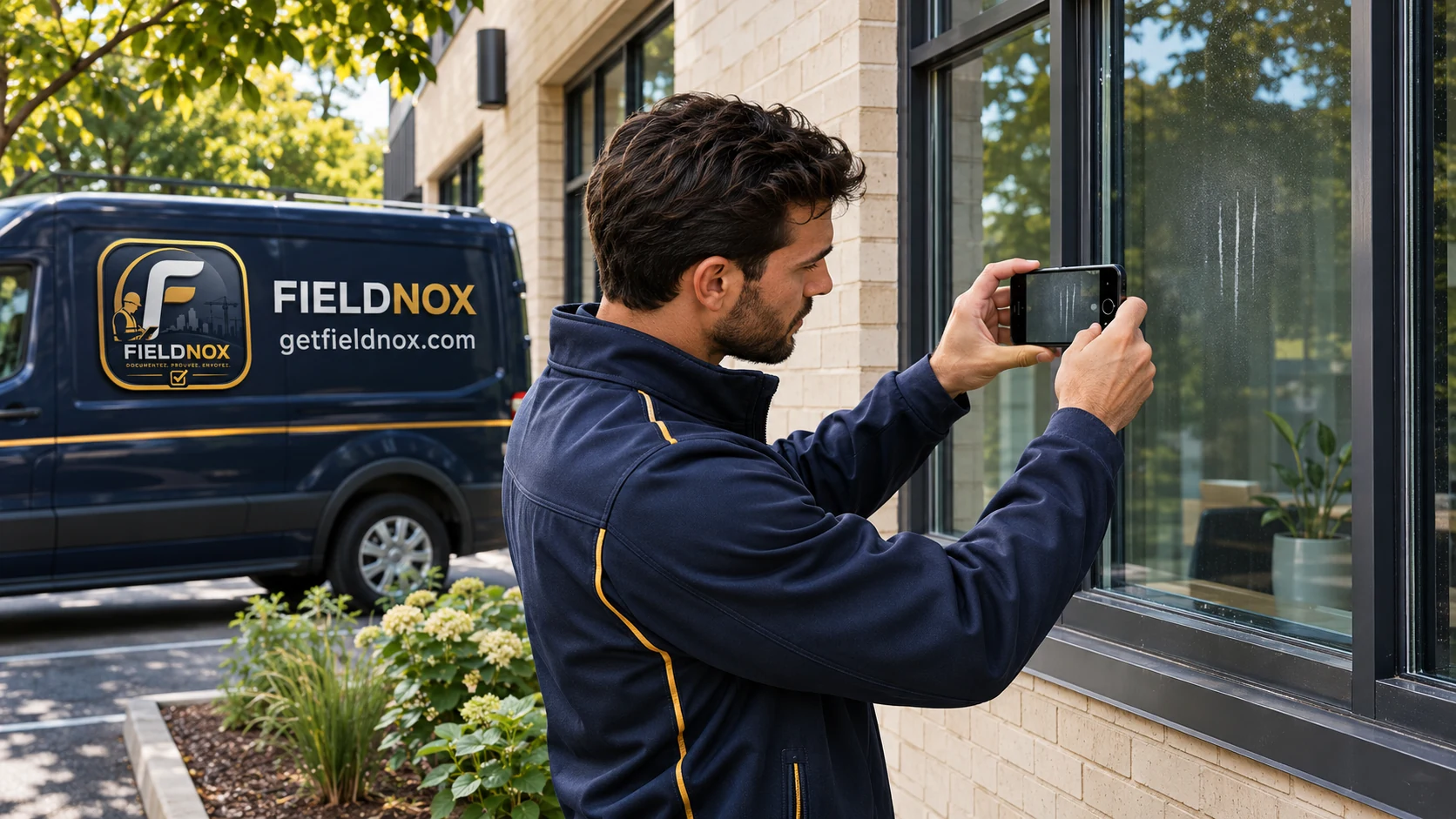
Free service callback templates
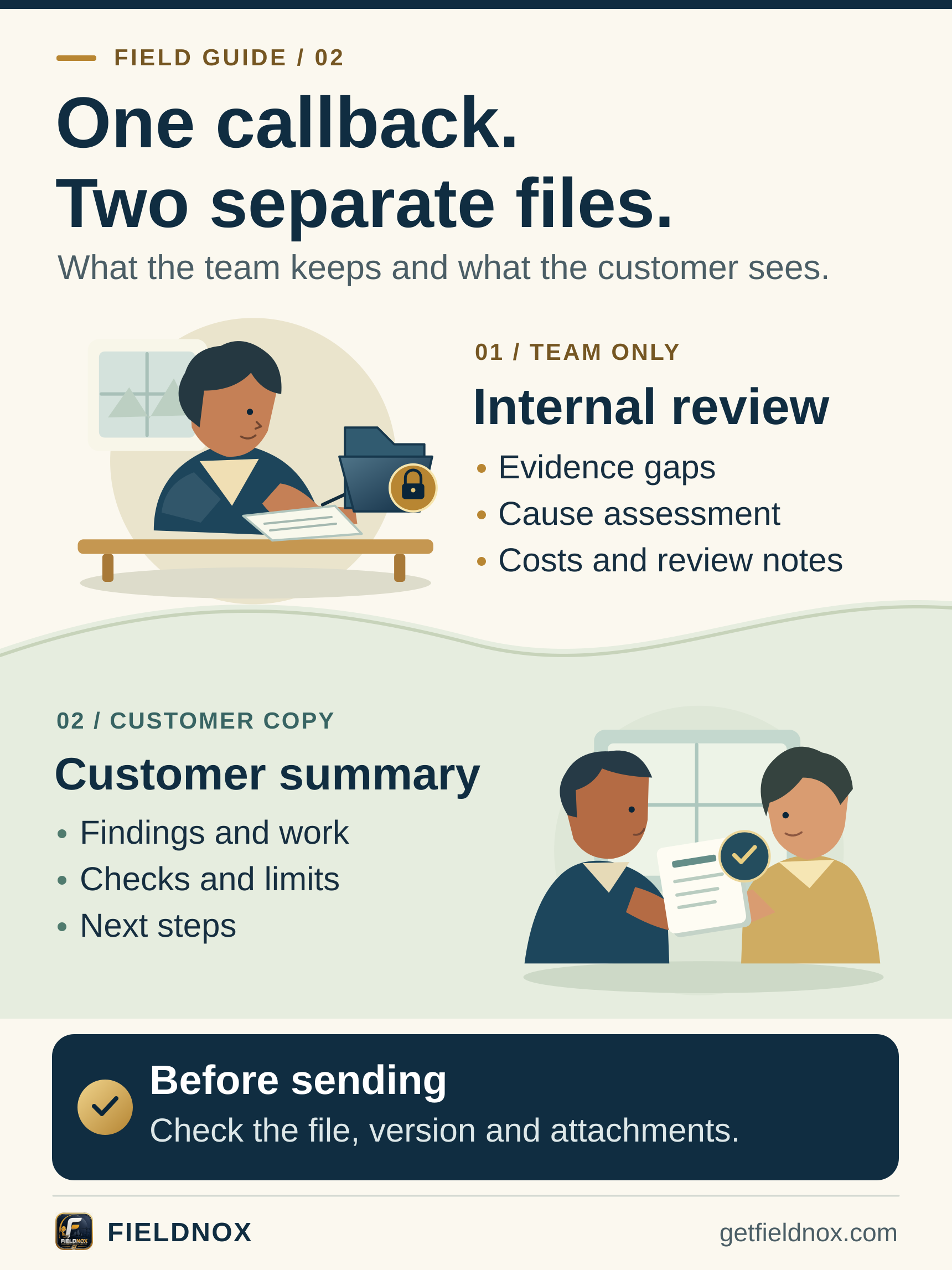
Use two separate documents: an internal review for your team and a customer summary prepared as a new file. Keep a separate return-visit reference so the original report remains identifiable. Never send the internal review to the customer.
Internal callback review
Download the internal review (.txt), or copy the manual template below.
View and copy the internal review template
INTERNAL SERVICE CALLBACK REVIEW — MANUAL TEMPLATE
Internal use only. Do not share this file with the customer.

References and request
Original job / report version / completion date:
Agreed scope / relevant exclusion reference:
Issue reference / return-visit reference:
Reported by / date / time / time zone:
How reported: phone / email / message / other, with reference:
Customer's words / exact item or location:
First noticed: customer-reported date/time or not established:
Return already planned? Yes / No / Not established:
Authorized inspection or action / by whom / reference:
Customer/site photo capture and sharing rules checked / restrictions:

Return-visit record
Technician / date / arrival / departure / time zone:
Condition actually observed before action:
Before photos: reference / item / stage / caption:
Work actually performed / materials used:
Check performed / observed result / limits:
After photos: reference / item / stage / caption:
Work status: complete / partial / further visit needed:

Manager's internal review
Original evidence reviewed / what it does and does not show:
Cause: supported finding / not established / further check needed:
Evidence and reasoning supporting that conclusion:
Missing information / next check / responsible person / target:
Commercial review owner / decision reference or pending:
Reviewer / date / next review action:
Issue status: open / closed, with reason:
Separate customer-summary file / version / reviewer:
Separate customer summary
Download the customer summary (.txt), or copy these fields into a new customer document. Review that actual document and its attachments before sharing it.
View and copy the customer summary template
SERVICE CALLBACK CUSTOMER SUMMARY — MANUAL TEMPLATE
Create this as a separate customer document. Do not attach the internal review.

Job / customer / site:
Original job reference / issue reference / return-visit reference:
Visit date / time zone / prepared by:
Reported concern / exact item or location:
Relevant observations before action:
Authorized action actually performed:
Supporting photo references / captions:
Checks performed / observed results / inspection limits:
Work status: complete / partial / further visit needed:
Remaining action / responsible person / target date or dependency:
Customer acknowledgment: person / date / time / exactly what was confirmed:
If not obtained: record that fact / handover route:
Report version / prepared by / reviewed by / date:

Before sharing, inspect this actual file and its attachments for the correct
job, visit, version and intended content. Exclude internal hypotheses, staff
discussion, private cost records and private commercial review notes.
Start with the original job, not a conclusion
Retrieve the agreed scope, original report and relevant photos. Identify the particular item or location the customer is asking about. “Front window W-03” is more useful than “the windows.”
Keep the customer's words distinct from your findings. “The marks are still there” is a reported concern. It does not establish when the marks appeared or what caused them.
Also check whether a return was already planned. A booked second stage, a new request and an unplanned concern about completed work need different handling. If the relationship to the original work is unclear, record that uncertainty rather than choosing a cause to complete a form.
Internal review templateCustomer summary template
Capture evidence that answers this particular concern
The returning technician needs enough context to inspect the identified location, not a verdict about the previous crew.
Before taking or sharing photos, check the customer’s and site’s rules and record any restrictions. Keep unrelated people, screens and private information out of the frame where possible. If photography is restricted, record the limit and use the permitted form of documentation.
Record the condition before taking action. Use an establishing photo to identify the location and a closer view of the reported issue. After work, capture a comparable view and describe the check actually performed.
For each reference, include the visit, item, stage and a factual caption. The before-and-after photo reporting guide explains how to keep those connections clear.
An original wide shot may identify the right elevation while being too distant to show a small mark. Say what it establishes and what it cannot establish. Do not enlarge a blurry image and describe newly visible detail as a verified original condition.
Worked example: marks reported after window cleaning
This example is fictional. It shows documentation decisions, not a customer result or a technical cleaning procedure.
Original job CL-284: Exterior glass cleaning on eight ground-floor office windows, W-01 to W-08, completed on Day 1. Internal glass and frames were outside the agreed scope. Original photo O-07 shows the front elevation, but not enough detail to assess small marks on individual panes.
New concern ISS-284-01: At 08:10 on Day 2, the customer's site contact calls our coordinator and reports: “Two front windows still have vertical marks.” The coordinator identifies the reported panes as W-03 and W-04 and creates return visit RV-284-01. When asked when the marks were first noticed, the customer's site contact cannot give a time; the coordinator records 'not established.' The original report is retained.
Return visit: One technician attends from 10:00 to 10:15 local time. Our coordinator authorizes inspection and repeat cleaning of the two exterior panes only, within the agreed boundary for this return visit. Charging remains under office review; the technician does not promise a refund or decide that the first crew was at fault.
| Record | Entry | What it supports |
|---|---|---|
| R-01, 10:03 | W-03 exterior, before repeat cleaning; vertical marks visible in the center of the pane | Condition observed on the return visit |
| R-02, 10:04 | W-04 exterior, before repeat cleaning; vertical marks visible near the lower center | Location and appearance before action |
| R-03 and R-04, 10:10 and 10:11 | Comparable views of W-03 and W-04 after repeat cleaning | Recorded appearance after the action |
| Technician note, 10:12 | From the exterior viewing position used for the check, the previously recorded marks were no longer visible | Result of that visual check; internal glass and frames were not inspected |
The manager reviews these records against O-07. The new images show that marks were present on the return visit and were no longer visible during the stated check after repeat cleaning. They do not establish whether the marks were missed originally or appeared afterward.
The review therefore records: condition addressed at the return visit; original cause not established from available evidence. The customer concern remains traceable without an unsupported workmanship finding.

Close the work and the follow-up separately
For RV-284-01, the technician's permitted work is complete. That does not automatically close the manager's review or the customer's communication record.
At 10:14, the customer's site contact views W-03 and W-04 and confirms that the reported marks are no longer visible from the agreed viewing position. Record that specific acknowledgment. It does not decide the cause of the marks, settle charging or expand the inspection to excluded surfaces.
The manager's next action is to test a location-based closeout check on the next comparable job: capture a useful view of each reported problem area after checking it. This is a process change to evaluate, not evidence that future callbacks will fall by a particular percentage.
When another visit is needed, leave the issue open with the next action, responsible person and target date, or state what must be confirmed before scheduling. Keep every return visit linked to the same issue reference; do not hide a third visit by opening an unrelated issue.
Keep the internal review out of the customer report
Keep review hypotheses, staff discussion and private commercial decisions in the internal review file. Prepare the customer summary as a separate document, containing only the concern, observations, authorized action, checks, limits and any next step relevant to the customer. Do not send the internal review file or print it as the customer report.
A customer summary for this example could read:
“Return visit RV-284-01 on Day 2 addressed the reported exterior marks on windows W-03 and W-04. Both exterior panes were cleaned again. Photos R-01 to R-04 record the before and after views. At the recorded exterior viewing positions, the marks were no longer visible during the final check. Internal glass and frames were not inspected. The customer's site contact reviewed these two panes at 10:14 and confirmed the marks were no longer visible from that position.”
Use this wording only when the underlying records support it. No cause, warranty conclusion or payment decision is implied by this summary.
If you review the effort spent on a return, use actual time and material records. The 15-minute visit in this example is only on-site elapsed time for one technician; it excludes travel and office work. The job cost difference guide covers reconciling cost records without treating an internal difference as an automatic customer charge.
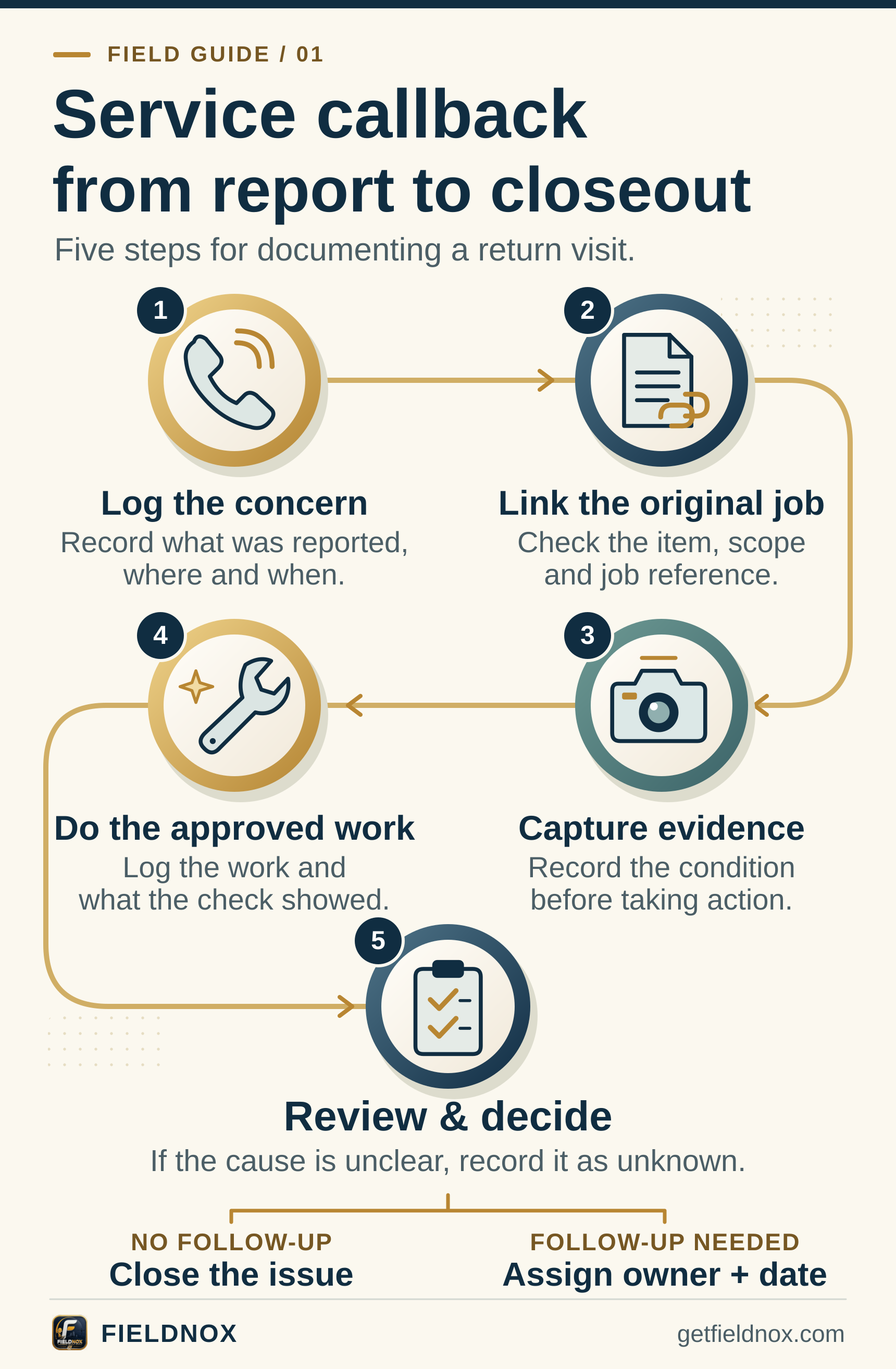
Five checks before closing a callback review
- Can another person find the original scope, issue and each return visit?
- Are the customer's report, technician's observations and manager's conclusion clearly distinguished?
- Does each conclusion have supporting evidence, with missing information stated?
- Are work status, next action and customer acknowledgment recorded separately from the commercial decision?
- Is the customer summary a separate file, and has its actual PDF or shared copy, including attachments, been checked for internal information and the correct visit references?
The purpose is a record your team can use to explain the return visit and choose the next action. It cannot guarantee fewer callbacks, establish responsibility from missing evidence or replace the review itself.
Use Fieldnox's free field service report template for the customer visit record, and keep the internal callback review in your team’s job file.